Learn · 01
What is a qubit?
A computer stores everything as bits. A bit is either 0 or 1, like a light switch that is either off or on. Inside a chip, a bit is a small amount of electric charge held in place: charge present means 1, charge absent means 0. Text, photos and this sentence are all long rows of them.
A qubit is the quantum version of a bit. It’s also a physical thing, but one small or cold enough to follow quantum rules. The machines being built today use a few different kinds:
- A tiny superconducting circuit, cooled to a fraction of a degree above absolute zero, which can hold a low or a high amount of energy.
- A single charged atom held still by electric fields, with one of its electrons in a low or a high energy level.
- A single particle of light, a photon, using the direction it vibrates in: up and down for 0, side to side for 1.
Each one has two distinct states that play the part of 0 and 1. The difference from a bit is that a qubit doesn’t have to be in one or the other. It can be in a blend of both, called a superposition.
A compass is a good way to picture a blend. North-east is a direction in its own right, but it’s made of some north and some east. A qubit’s state is a direction made of some 0 and some 1. The two amounts are called amplitudes, one for 0 and one for 1.
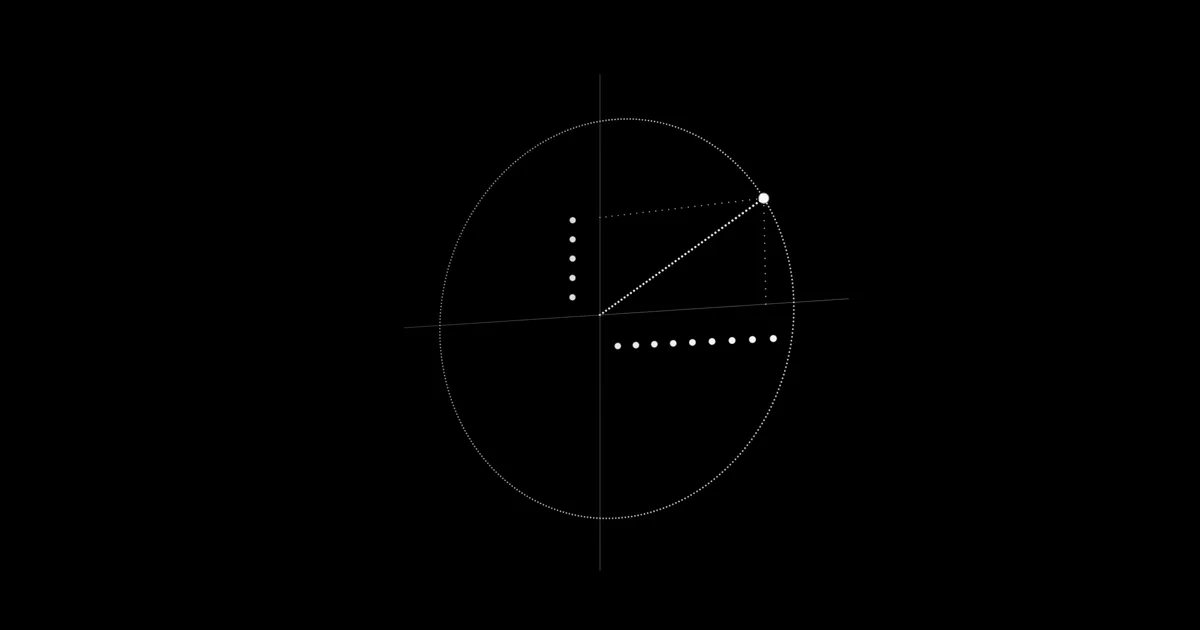
The picture below draws a qubit’s state as an arrow. Pointing right means 0. Pointing up means 1. In between is a blend, and the arrow’s shadow on each axis is that value’s amplitude. The rows of dots show the same two amplitudes, one dot for every 0.1.
Drag the arrow or the slider. Each dot is 0.1 of amplitude.
The arrow always has length 1, so the two amplitudes are tied together. As one grows the other shrinks, and their squares always add up to exactly 1. The reason has to do with measurement.
Past 90 degrees, the amplitude for 0 turns negative and its dots turn into rings. A negative amplitude has no everyday meaning, and on its own it changes nothing you can observe. It matters when amplitudes are combined, which is called interference.
One simplification is worth knowing about. In a real qubit, each amplitude is a complex number, which adds a second ingredient called phase, and the arrow in a circle becomes an arrow in a sphere. Every idea in these lessons works the same way with ordinary positive and negative numbers, so the flat version is used here.