Learn · 02
What happens when you measure a qubit
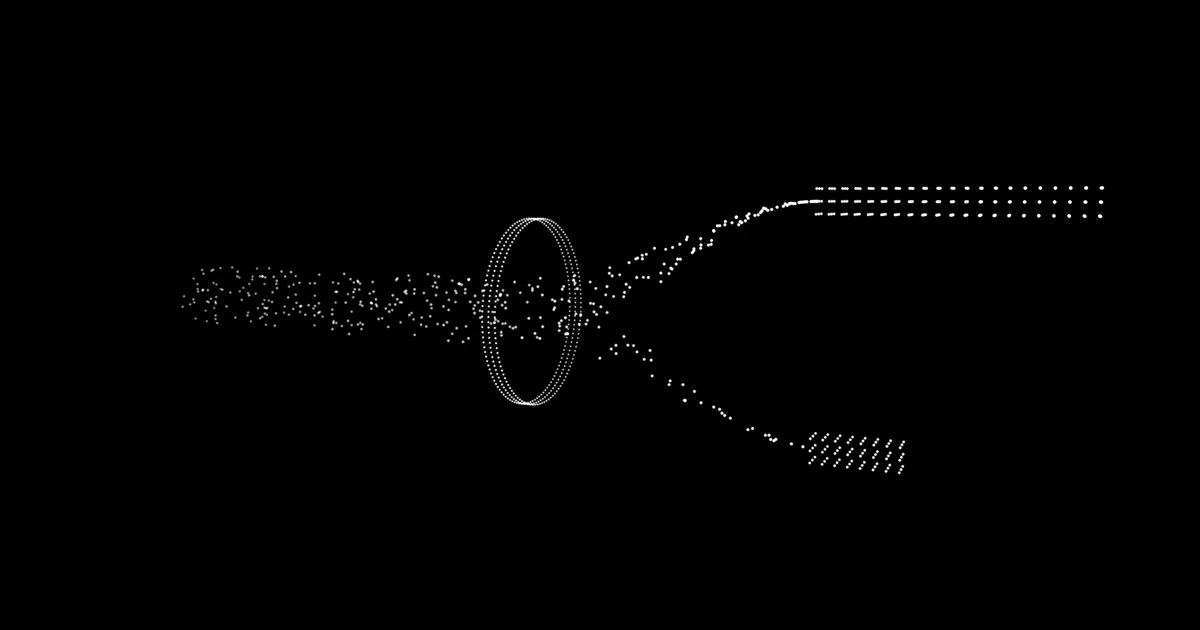
A superposition can’t be read directly. The only way to get information out of a qubit is to measure it, and a measurement always returns a plain 0 or a plain 1.
The amplitudes set the odds. The chance of getting 0 is the amplitude for 0 squared, and the same goes for 1. An arrow 30 degrees up from 0 has amplitudes of 0.87 and 0.50, so it reads 0 about 75% of the time (0.87 × 0.87) and 1 about 25% of the time (0.50 × 0.50). That’s why the squares always add up to 1: they are the chances of the only two possible outcomes.
Polarized sunglasses make this kind of measurement all day. Each photon of light vibrates in some direction, and that direction is a qubit. The lenses only let through light vibrating one way, so every photon that reaches them gets measured: it either passes or it’s blocked, never half of each. When a photon’s direction is tilted away from the lens’s, its chance of passing is the amplitude squared, exactly as above. Many phone screens give off light vibrating in a single direction, which is why the screen dims and then goes dark as you tilt your head while wearing them.
Measuring also changes the qubit. Once it returns 0, the qubit is a plain 0, and measuring it again gives 0 every time. The blend is gone. A photon that got through the sunglasses now vibrates in the lens’s direction, so a second lens lined up behind the first lets it straight through. The only way to see the odds is to prepare the same blend again, measure again, and count.
The simulation does that. Set the arrow, then measure fresh copies of the same qubit, one at a time or a hundred at once.
A single result tells you very little. A qubit with a 50% chance of 1 and one with a 1% chance of 1 can both return 1 on the first try. Only a tally across many copies shows the odds, and even the tally can’t show whether an amplitude is positive or negative, because squaring hides the sign.
The same rules hold for several qubits together. Four qubits can hold a blend of all sixteen four-digit combinations from 0000 to 1111, each with its own amplitude. Measuring them returns one combination, picked with chances set by the squared amplitudes, and the rest of the blend is lost. Holding sixteen possibilities at once is easy. Getting a useful one out takes interference.