Learn · 05
How two qubits become entangled
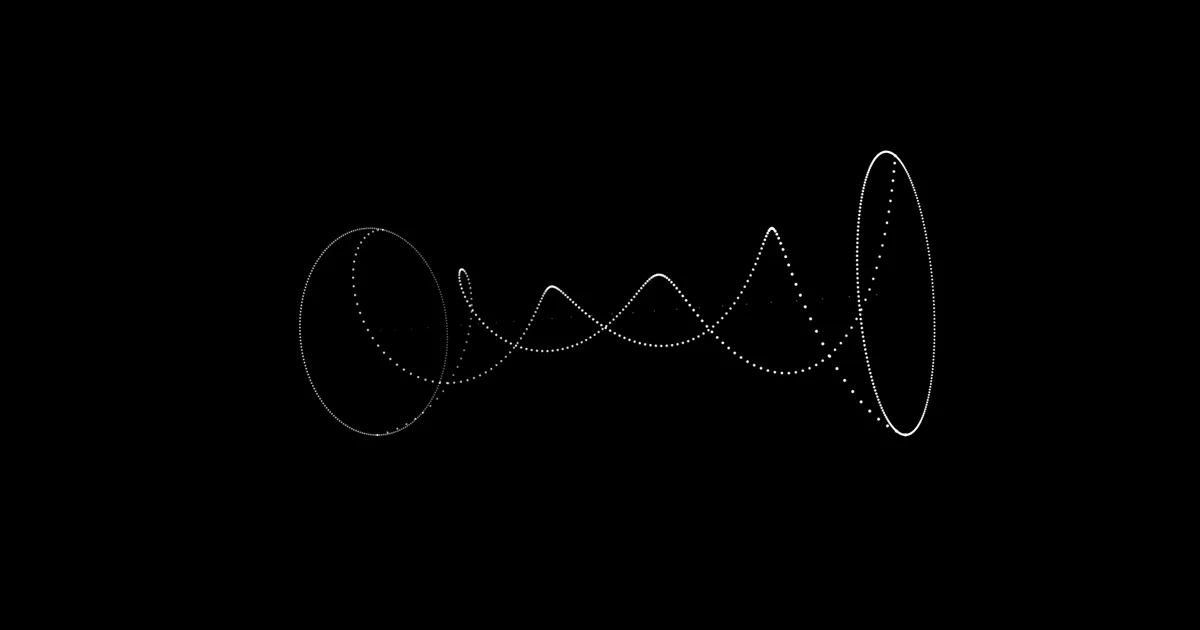
Two qubits measured together give one of four results: 00, 01, 10 or 11. Call the qubits A and B, with A’s digit first. Each of the four results has its own amplitude, and its chance is that amplitude squared, the same rule as for one qubit.
Usually the pair can be described one qubit at a time. If A is an even blend of 0 and 1 and B is a plain 0, the amplitudes are 0.71 for 00, 0.71 for 10, and 0 for 01 and 11. Each one is A’s amplitude times B’s: 0.71 × 1 for 00, 0.71 × 0 for 01, and so on.
A gate that works on two qubits at once can change that. The simplest is called Link here. (Its proper name is CNOT, for controlled-NOT.) Link flips B wherever A is 1, so the amplitude for 10 moves to 11 and the amplitude for 11 moves to 10. Apply it to the blend above and the amplitudes become 0.71 for 00, 0.71 for 11, and 0 for the other two.
No pair of separate qubits gives those numbers. For 01 to be 0, either A’s amplitude for 0 or B’s amplitude for 1 would have to be 0, and either one would also make 00 or 11 zero. The pair has a state, but neither qubit has one of its own. That’s entanglement.
Measuring shows what it means. Each measurement gives 00 or 11, half the time each. A on its own looks like a coin toss, and so does B, but they always agree. If A gives 1, so does B.
Try Mix A, then Link, then measure a hundred copies. Then reset and try Mix A and Mix B with no Link. That gives each qubit its own even blend. Each qubit’s results look just as random as before, but now A and B agree only about half the time.
Each column is one outcome: the first digit is A, the second is B. ● is +0.1 of amplitude. ○ is −0.1.
Matching results alone would be easy to fake. Put a red card and a blue card in two envelopes and mail one to each of two people. Whoever opens theirs first knows what the other one has. Entangled qubits go further, but showing it takes more than one kind of measurement: each qubit’s arrow is turned by some angle before it’s measured, and the angles are chosen at random. With the right choice of angles, entangled pairs give matching answers about 85% of the time. No plan fixed in advance, envelopes included, can do better than 75%. John Bell worked out that limit in 1964. Experiments by John Clauser, Alain Aspect and Anton Zeilinger showed real particles beat it, and the three shared the 2022 Nobel Prize in Physics.
Entanglement can’t send a message. Whatever is done to A, B’s results on their own stay 50/50. The pattern only appears when the two lists of results are put side by side, and getting them side by side takes an ordinary phone call or network link.
For a quantum computer, entanglement is what makes qubits hard to imitate. Ten separate qubits can be written down as ten arrows, two numbers each. Ten entangled qubits need an amplitude for each of their 1,024 possible results. Each extra qubit doubles that count. Fifty qubits need about a thousand trillion amplitudes, which takes about 18 million gigabytes to store. Grover’s search and Shor’s algorithm both entangle their qubits along the way.
Entanglement is also fragile. Any stray contact between a qubit and its surroundings, such as heat, vibration or a passing electric field, entangles the qubit with the outside world a little. Part of its state leaks into the surroundings, where the computation can’t use it, and the amplitudes drift. This is called decoherence, and it’s the main reason today’s quantum computers make so many errors.